The Trust Crisis in Alarm Systems
Understanding the fundamental challenges facing modern security alarm infrastructure
1.1 Understanding the Problem
The security alarm industry operates under a paradox that has persisted for decades and continues to undermine its fundamental purpose. Despite continuous technological advancement and increasing sophistication in detection mechanisms, the overwhelming majority of alarm activations represent false positives rather than genuine security threats. Industry data consistently demonstrates that false alarm rates exceed ninety-five percent across most conventional alarm systems, creating a situation where security personnel and emergency responders must treat every alarm with skepticism rather than urgency. This pervasive distrust has transformed what should be a critical security tool into a source of frustration and wasted resources.
The roots of this crisis extend deep into the fundamental design philosophy that has guided alarm system development for generations. Traditional approaches have prioritized sensitivity above all other considerations, operating under the assumption that detecting every possible anomaly represents the optimal strategy for security. This philosophy has led to systems that generate alerts for an extraordinarily wide range of events, from actual security breaches to environmental factors like weather changes, animal movement, equipment malfunctions, and user errors. The result is a flood of alerts that overwhelms monitoring personnel and creates a dangerous environment where genuine threats become lost in the noise of false alarms.
The consequences of this trust crisis extend far beyond simple inconvenience. When security personnel and emergency responders encounter false alarms repeatedly, they develop response fatigue that fundamentally alters their approach to alarm events. Studies have shown that response times increase significantly as false alarm rates rise, with personnel unconsciously deprioritizing alarm responses based on their historical experience with false positives. This creates a dangerous feedback loop where the very systems designed to enhance security actually reduce the effectiveness of security responses when genuine threats occur. The economic impact is equally significant, with billions of dollars wasted annually on unnecessary emergency responses, investigation of false alarms, and the opportunity cost of diverted security resources.
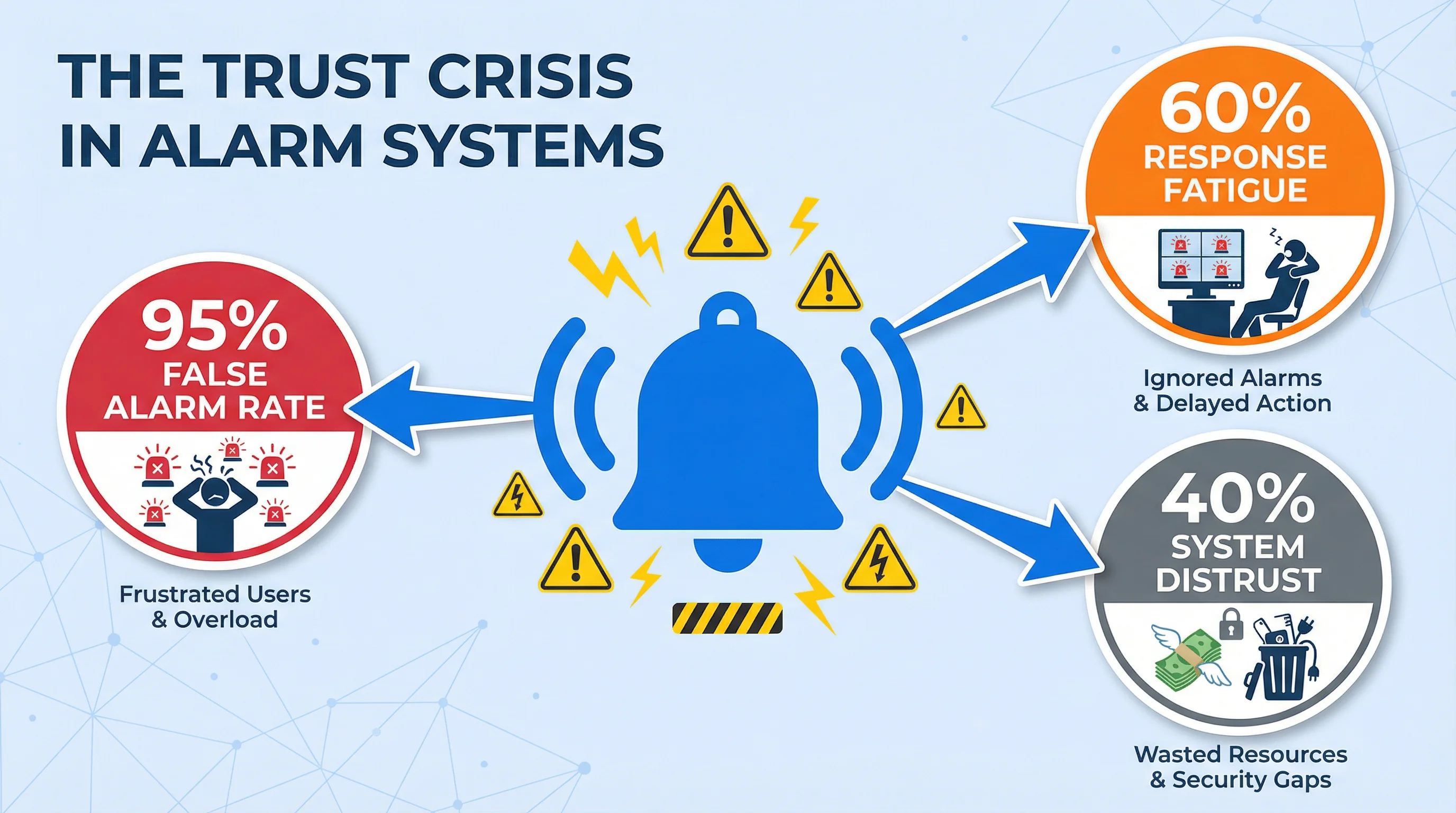
Figure 1.1: The Trust Crisis in Alarm Systems - Key Statistics and Impact Areas
1.2 Impact on Industry
The trust crisis in alarm systems has created cascading effects throughout the entire security industry ecosystem. Security service providers face mounting pressure from clients who question the value of systems that generate constant false alarms while failing to provide reliable protection. Insurance companies have responded by implementing increasingly stringent requirements for alarm system verification before dispatching emergency services, adding layers of complexity and delay to the response process. Law enforcement agencies in many jurisdictions have implemented fine structures for excessive false alarms, creating financial penalties that further erode the value proposition of traditional alarm systems. These cumulative pressures have created an environment where the fundamental business model of alarm-based security faces serious questions about its long-term viability.
The economic implications of the trust crisis extend across multiple stakeholder groups and represent a significant drag on industry growth and innovation. Security service providers must allocate substantial resources to managing false alarms, including call center operations to verify alerts, technician visits to adjust overly sensitive systems, and customer service efforts to address client frustration. These operational costs directly impact profitability while simultaneously reducing the resources available for genuine security improvements. For end users, the costs manifest in multiple forms including direct financial penalties for false alarms, increased insurance premiums, reduced property values in areas with high false alarm rates, and the intangible but significant cost of reduced peace of mind when alarm systems cannot be trusted.
Beyond the immediate economic impacts, the trust crisis has created a broader credibility problem that affects the entire security industry. When alarm systems consistently fail to deliver on their fundamental promise of reliable threat detection, it undermines confidence in security technology more broadly and creates resistance to adopting new security solutions. This credibility gap has opened opportunities for alternative security approaches that bypass traditional alarm systems entirely, including increased reliance on video surveillance without alarm integration, security personnel without technological support, and passive security measures that avoid the false alarm problem by eliminating active detection altogether. These alternatives often provide inferior security outcomes but gain traction because they avoid the frustration and cost associated with unreliable alarm systems.
1.3 Root Causes of False Alarms
Understanding the root causes of false alarms requires examining the complex interplay of technological limitations, environmental factors, human behavior, and system design choices that contribute to the problem. At the technological level, traditional alarm sensors operate on relatively simple detection principles that struggle to distinguish between genuine security threats and benign events that trigger the same sensor responses. Motion detectors cannot inherently differentiate between an intruder and a pet, curtain movement from HVAC systems, or shadows from passing vehicles. Door and window sensors cannot distinguish between unauthorized entry and a door left slightly ajar by wind or building settlement. Glass break detectors respond to any sharp acoustic signature regardless of whether it represents actual glass breakage or simply a loud noise with similar frequency characteristics.
Environmental factors represent another significant category of false alarm triggers that traditional systems struggle to address effectively. Weather events including high winds, heavy rain, temperature extremes, and barometric pressure changes can all trigger various types of sensors through multiple mechanisms. Wind can cause building movement that triggers motion sensors, create vibrations that activate glass break detectors, and physically move doors and windows enough to trigger contact sensors. Temperature changes cause building materials to expand and contract, potentially triggering sensors calibrated for specific conditions. Wildlife and insects can trigger motion sensors, particularly in outdoor applications or buildings with pest problems. These environmental factors are inherently unpredictable and difficult to filter out without sophisticated analysis that goes beyond simple threshold-based detection.
Human factors contribute substantially to false alarm rates through a combination of user error, inadequate training, and system complexity that exceeds typical user capabilities. Users frequently forget to disarm systems before entering protected areas, enter incorrect codes that trigger alarm conditions, fail to properly secure doors and windows before arming systems, and inadvertently trigger sensors through normal activities that the system interprets as threats. These user errors are not simply a matter of carelessness but reflect fundamental mismatches between system design and actual user behavior patterns. Systems designed with complex arming and disarming procedures, multiple zones with different requirements, and inadequate feedback about system status create conditions where user errors become inevitable rather than exceptional.
| False Alarm Category | Percentage of Total | Primary Contributing Factors | Mitigation Difficulty |
|---|---|---|---|
| User Error | 45% | Incorrect code entry, forgotten arming/disarming, inadequate training | Medium |
| Environmental Triggers | 25% | Weather events, temperature changes, wildlife, building movement | High |
| Equipment Malfunction | 15% | Sensor degradation, power issues, communication failures | Medium |
| Installation Issues | 10% | Improper sensor placement, incorrect sensitivity settings | Low |
| Unknown/Other | 5% | Unexplained activations, multiple simultaneous factors | Very High |
System design choices and installation practices represent a final category of root causes that often receive insufficient attention in discussions of false alarm reduction. Many false alarms result from fundamental mismatches between system capabilities and the specific security requirements of individual installations. Sensors installed in locations with high environmental variability, systems configured with sensitivity settings inappropriate for the protected environment, and security zones that fail to account for normal building usage patterns all contribute to elevated false alarm rates. These installation and configuration issues often persist because they require specialized expertise to identify and correct, and because the incentive structures in the security industry often prioritize rapid installation over careful customization and optimization.
The complexity of these root causes underscores why simple solutions have failed to resolve the false alarm crisis despite decades of effort. Addressing the problem effectively requires moving beyond incremental improvements to individual components and instead adopting a holistic approach that integrates multiple verification mechanisms, incorporates intelligent analysis of sensor data, accounts for environmental and behavioral factors, and provides continuous optimization based on actual system performance. This comprehensive approach represents a fundamental shift from traditional alarm system design philosophy and requires significant investment in new technologies, processes, and expertise. However, the alternative of continuing with systems that generate false alarms in ninety-five percent of activations is simply not sustainable for an industry that aspires to provide reliable security protection.